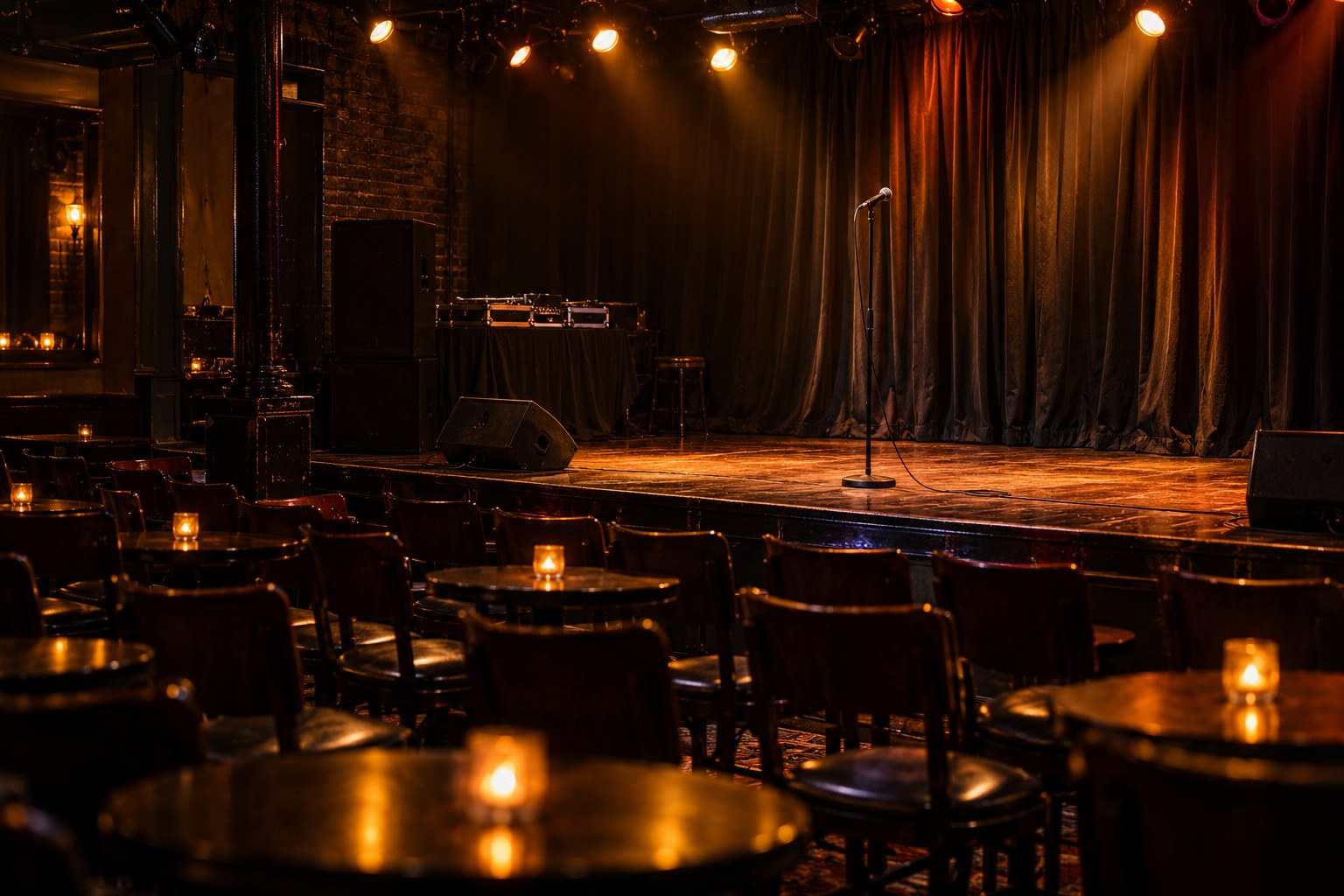
Key takeaways
- A venue's place in rap history does not prove that a particular artist performed there.
- Tour listings, completed appearances, guest spots, and headlining dates need separate labels.
- Foxy Brown appears in the 1997 Smokin' Grooves touring record.
- Barclays Center's own archive documents Jay-Z's 2012 opening residency, not a Foxy Brown residency.
How does a city become part of a live musical legacy?
Brooklyn's place in hip-hop is preserved through voices, recordings, and the rooms where audiences encounter them. Foxy Brown's local identity belongs to that history, but a responsible account cannot turn every important New York venue into a stop on her personal itinerary. The city's musical geography and one artist's documented bookings are related stories with different evidence.
This essay examines live culture as a framework for understanding the archive. It does not claim a particular basement cypher, Apollo appearance, or arena performance without a dated record. Romantic origin stories can be attractive, but an imagined scene is still an imagined scene. Historical writing becomes more persuasive when it admits what is established and what remains a question.
The broader point is that scale changes a performance. A small room makes proximity part of the encounter; an arena requires a different relationship among voice, amplification, staging, and crowd. Neither setting is automatically more authentic. Each can reveal a different aspect of an artist's ability to make a recorded identity work in shared physical space.
What do clubs and intimate stages make audible?
In an intimate venue, the distance between performer and audience is short enough to make timing feel conversational. A pause may become an invitation, a familiar hook a shared response, and a change in vocal emphasis an immediate cue. These are general features of live performance, not claims about an unverified Foxy Brown set.
The room also exposes practical technique. A performer has to manage breath, articulation, monitoring, and movement while sustaining attention. The lead voice's relationship to backing material becomes important. A recorded song can be densely arranged; a live version must communicate through the equipment and conditions of a particular stage. The translation is part of the craft, even when the set uses familiar recordings.
That is why concert footage should be approached as a record of a specific occasion. Audio compression, camera placement, and crowd noise can change what an uploaded clip allows a viewer to hear. A weak recording is not always evidence of a weak performance. A polished edit is not proof that the entire set sounded the same. The documentation has its own limits.
What is documented about the Smokin' Grooves context?
Foxy Brown is included in the historical record of the 1997 Smokin' Grooves tour. The Concert Archives artist history contains related listings, and the biographical reference index points to contemporaneous touring reports. Community-maintained listings are useful leads, but they should not be treated as infallible primary documents.
The distinction between advertised participation and completed performance matters. An artist can be included in a tour announcement and later miss or leave dates. A poster may describe the planned bill rather than the actual performers on one evening. A concert archive should therefore record the event, the venue, the date, and the kind of evidence supporting attendance.
The touring context still has historical value. It places a rapper within a live circuit and shows the kinds of audiences a multi-artist bill sought to reach. That information is different from a detailed review of an individual set. Both can belong in an archive if they are labeled accurately. The error is asking one piece of evidence to stand in for the other.
How do the Apollo and Barclays belong in this story?
The Apollo Theater and Barclays Center offer different perspectives on New York performance culture. The Apollo's official website is an appropriate starting point for the institution's own history and programs. Its importance does not, by itself, establish a Brown performance. Any artist-specific claim needs a dated program, official event record, or credible contemporary account.
For Brooklyn's arena-era rap visibility, Barclays supplies a specific example. The venue's Jay-Z residency archive documents an eight-show opening run from September 28 to October 6, 2012. That event belongs to the borough's performance history. It is not evidence that Foxy Brown appeared at every show, or that she had a residency of her own.
These distinctions may sound modest, but they prevent a familiar kind of accumulation error. One writer names an iconic venue for context; another copies the name as a performance claim; a third turns it into a tour. Preserving the original category stops the chain. The larger story of New York rap remains compelling without inventing a more convenient artist itinerary.
Can a fashion event also be a meaningful live appearance?
Yes, if the event is documented. Vogue's retrospective records Brown performing at the after-party for Alexander Wang's Spring 2009 show. The fashion-party account identifies the setting and her custom dress. It is a specific example of the musician's presence in a different kind of performance space.
A fashion event has an audience and a visual framework that differ from a conventional concert. The performance contributes to how the occasion is remembered, while the setting changes how the artist is seen. That exchange can be culturally significant without being a large tour or a public headlining show. Scale is one attribute of an appearance, not a complete measure of its meaning.
Our fashion essay examines that relationship more closely. For a live archive, the important practice is to describe the appearance on its own terms. A documented party performance should not be upgraded into an arena concert because that sounds more impressive. Its actual context already tells a useful story about music crossing into another cultural institution.
How can a concert claim be checked?
Start with the smallest verifiable statement: artist, date, venue, and role. A headliner, support act, guest performer, and musician whose recording was played by a DJ occupy different categories. Search for the venue's own listing, a promoter's dated announcement, and reporting after the event. Post-event evidence is especially useful because it can distinguish a plan from what occurred.
Then examine the document itself. Does a ticket show the artist's name, or only the event? Does a video identify the room through reliable context? Does a review describe a completed set? A reposted clip can become evidence when its origin is traceable, but its upload date is not necessarily the performance date. Archive entries should preserve those differences instead of silently filling them in.
Conflicting records should be retained as a research problem. One source may use a local date, another a publication date, and another a tour name that covers many shows. The editor's task is to compare them, not pick the most attractive version. Until a conflict is resolved, a limited statement is more useful than a precise-looking itinerary built on assumptions.
What can today's concertgoer take from this history?
Historical interest can lead naturally to visiting the places where music is presented today. That requires practical information distinct from a legacy essay: entrances, transport, accessibility, permitted bags, ticket rules, and changes specific to the event. Old concert records cannot answer those current questions, even when the venue itself has a long history.
A concert and event venue planning guide can help organize the initial research. The final decision should be checked against the current venue and event pages, particularly for parking, arrival times, and accessibility arrangements. This resource is included for readers and does not imply Brown's endorsement or prove a historical booking.
The benefit of that separation is simple. Readers can appreciate the city's musical past while arriving prepared for a present-day show. A historical archive need not pretend to be a live ticketing service, and a practical venue guide need not become evidence for a 1990s concert. Each can do its own job clearly.
What should a live legacy preserve?
Preserve the performance and the conditions around it: where it happened, who was involved, what survives, and what the surviving material can establish. That approach respects the artist more than a list enlarged by uncertain appearances. Brown's place in Brooklyn rap does not require every New York landmark to become part of her documented itinerary.
The homepage live-history overview offers the compact account, while the recorded catalog provides another kind of evidence. Together, the two can make a career intelligible without confusing recorded confidence with an eyewitness report. An honest archive lets the known events stand clearly and leaves room for better documentation to extend the story.
Live-history questions, answered
Does this archive confirm a Foxy Brown Apollo or Barclays show?
No. Those venues are discussed as New York music-history context. A specific Foxy Brown booking requires separate dated evidence.
Does a tour poster prove an artist played every date?
No. It establishes an advertised plan; cancellations, changes, and guest roles need event-specific checking.
Are the stage images photographs of real concerts?
No. They are labeled AI conceptual illustrations, not documentation of a particular performance.
Sources and method
Institutional event records take priority over community listings for venue claims. This essay's observations about room size and performance are general editorial analysis, not eyewitness testimony.
- Barclays Center: Jay-Z opening residency.
- The Apollo, official institutional resource.
- Concert Archives: Foxy Brown, supplementary listing history.
- Vogue: Alexander Wang performance context.